
Reconstruction era – 1874-1877
Part of the ‘Smith family history’ series
The Scofield v. McNaught case was decided in the Georgia Supreme Court January term in 1874. I’m certainly no lawyer and will spare you my attempt to try and interpret the decision, but feel free to read through it yourself.
It is interesting to note that in the Georgia code as recently as 2020, the definition of “usury” includes the following reference to the case:
Payment of sum exceeding lawful rate under guise of rent usurious.
2020 Georgia Code, Title 7 – Banking and Finance, Chapter 4 – Interest and Usury, Article 1 – In General, § 7-4-1. “Usury” Defined
- When vendee of property is to pay a vendor 10 percent on purchase money until it is settled in full, under name of rent, such contract is usurious on the contract’s face. Scofield v. McNaught, 52 Ga. 69 (1874).
The 1874 Beasley’s Atlanta Directory is the first evidence I could find indicating an actual residential house number for Robert Windsor Smith and his family. As discussed in a previous post, the residence is listed as 339 Whitehall (renumbered to 385 in 1892), and the Smith family would live there until their move to Kirkwood sometime in 1890.
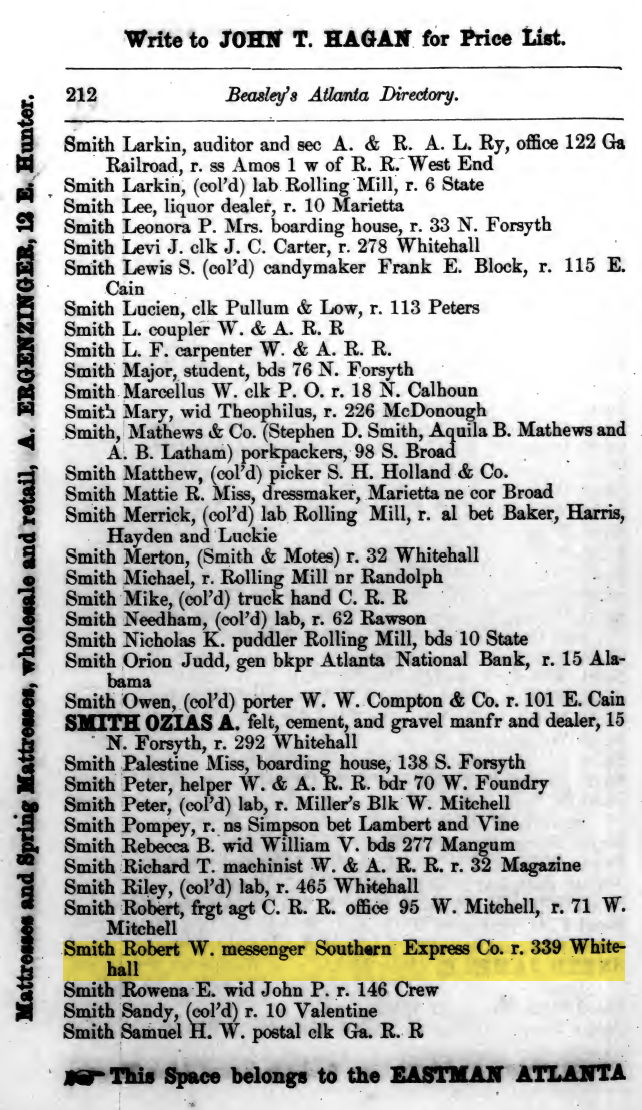
On March 27, 1874 Mary gave birth to her and Robert’s daughter Pauline Spencer Smith following the tragic death of ~2 year old Roberta Cleveland Smith in 1873. She seems to have generally gone by the name Spencer rather than Pauline. This was Mary’s fifth childbirth and Spencer’s living siblings at this time were Eugene (6) and Evelyn (4). Presumably Robert’s employment at the Southern Express was not impacted by the depression of 1873, and tax digests show the aggregate value of his property to be around $3,000 at this time.
I’m not sure to what extent Robert was involved with management of tenants, but the retail storefronts at 54 & 56 Whitehall continued to have a rotating cast of tenants through the end of the Reconstruction era. The 1874 city directory lists a variety of people and businesses with the Whitehall addresses, including some surprising residential listings for 56 Whitehall.
| 54 Whitehall Tenants | 56 Whitehall Tenants |
|---|---|
| ABBOTT BENJAMIN F. lawyer, 54 Whitehall, r. 225 Whitehall | Jenkins James W. K. bkpr Morrison, Bain & Co. r. 56 Whitehall |
| Alexander Joseph A. real estate dealer, 54 Whitehall, r. 163 Peachtree | McDairmed Angus, salesman Morrison, Bain & Co. r. 56 Whitehall |
| Alexander J. M. & Co. (Julius M. and Aaron Alexander) hardware whol. and ret. 54 Whitehall | MORRISON, BAIN & CO. (John Morrison, Donald M. Bain, and Angus Morrison) hardware importers and whol dealers, 56 Whitehall |
| Hammond George H. lawyer, 54 Whitehall, r. 39 Pulliam | Randall, Daifin & Co. (Philip D. Daffin, resident partner) cotton buyers and com mers, 56 Whitehall |
| Hammond Theodore A. asst inspector oils and fertilizers, 54 Whitehall, bds 226 Washington |
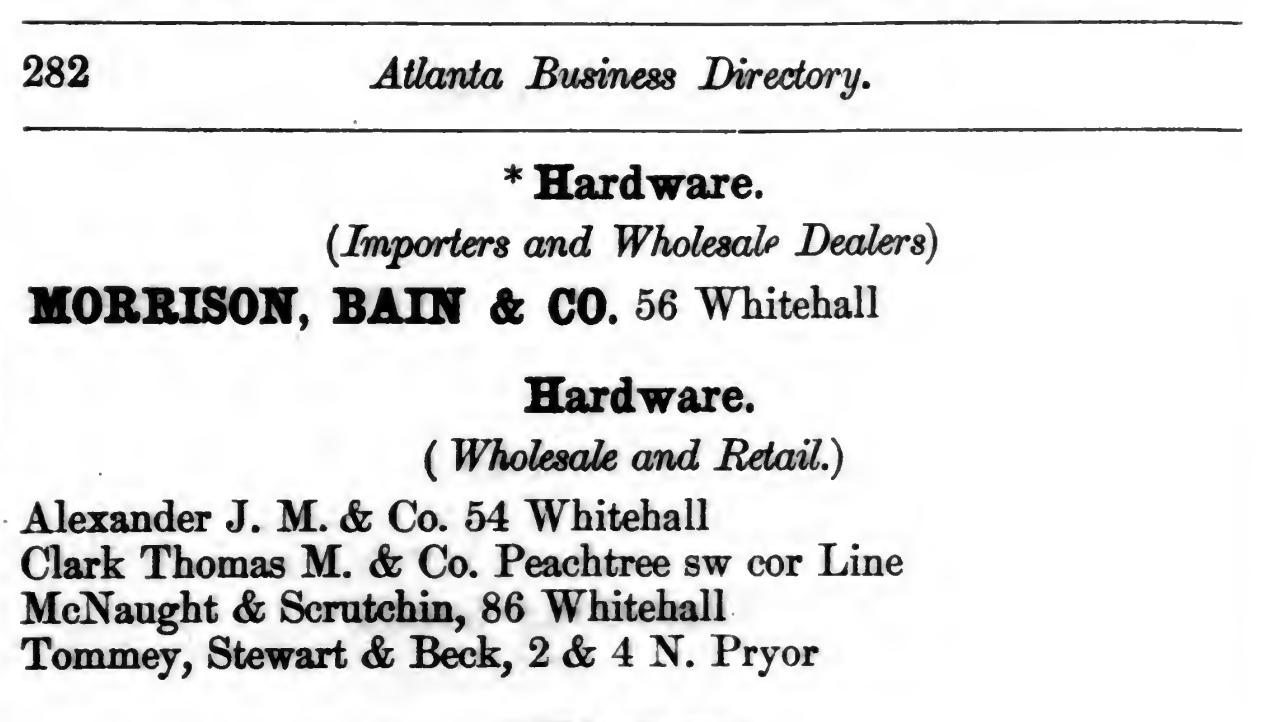
Additionally it’s interesting to note that three of the five listed hardware wholesalers / retailers in the 1874 business directory were located at 54, 56, or 86 Whitehall. The 86 Whitehall building was owned by William McNaught and served as his offices for both his hardware and paper mill businesses.

Additional retail tenants at 54 & 56 Whitehall between 1874 and 1877 include Furchgott, Benedict & Co., W. E. Cater, Lane & Cater, and R. P. S. Kimbro.


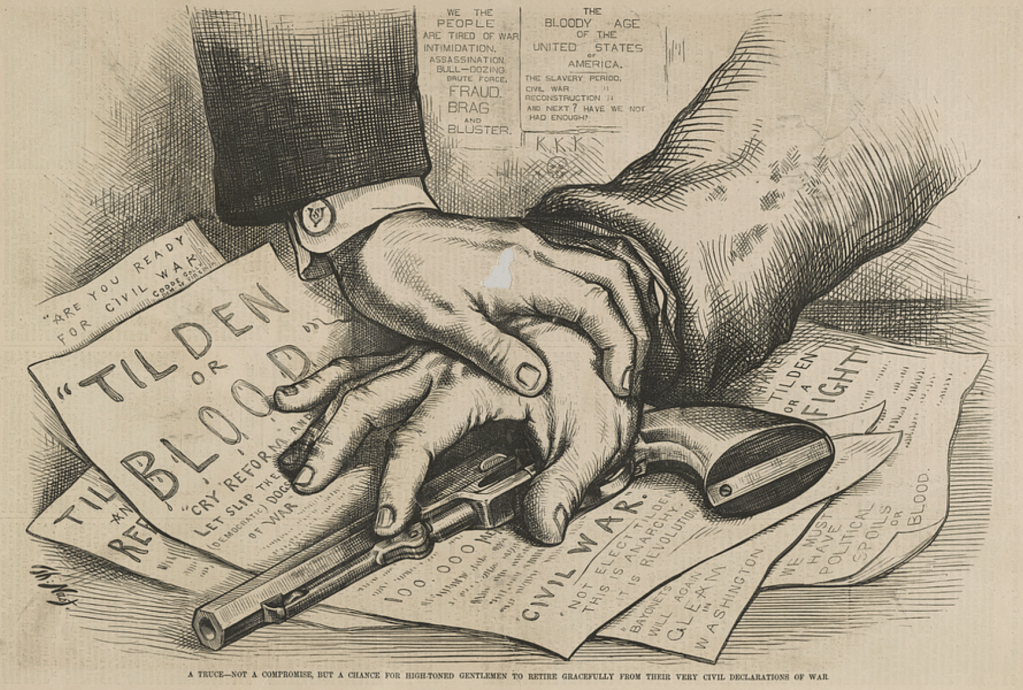
The contentious 1876 presidential election ultimately led to the Compromise of 1877, which resulted in the election of Rutherford B. Hayes, the withdrawal of Federal troops, and the end of the Reconstruction era.
Under the compromise, Democrats controlling the House of Representatives allowed the decision of the Electoral Commission to take effect, securing Hayes’s authority as a political fact, and the subsequent withdrawal of the last federal troops from the Southern United States effectively ended the Reconstruction Era and forfeited the Republican claims to the state governments in South Carolina, Florida and Louisiana. The outgoing president, Republican Ulysses S. Grant, removed the soldiers from Florida, and as president, Hayes removed the remaining troops from South Carolina and Louisiana. As soon as the troops left, many white Republicans also left, and the “Redeemer” Democrats, who already dominated other state governments in the South, took control. Some black Republicans felt betrayed as they lost their power in the South that had been propped up by the federal military, and by 1905 most black people were effectively disenfranchised in every Southern state.[4] The Democrats agreed to the election of Hayes and in turn he withdrew the Army from the South, leaving the Democrats in control there.
https://en.wikipedia.org/wiki/Compromise_of_1877
The conclusion of the Reconstruction era leads us to the dawn of the Gilded age. Up next we will look at more family changes for Robert and Mary as well as a major retailer who would become a long term resident of the 54 & 56 Whitehall storefronts.
 Birds of Kirkwood