
Reconstruction era – 1871-1873
Part of the ‘Smith family history’ series
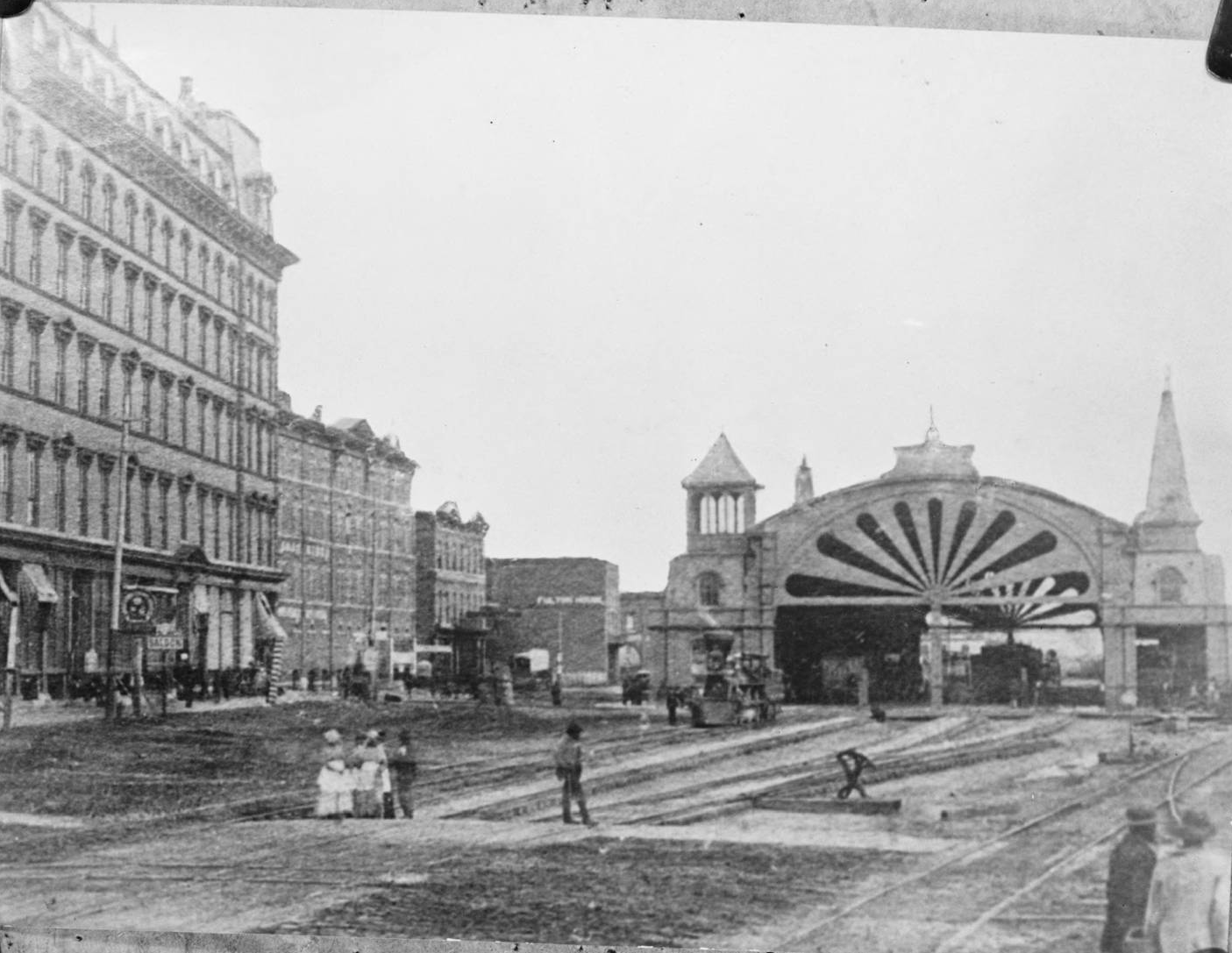
In the early 1870’s Atlanta was still rapidly rebuilding, including the commercial and retail area of downtown. The (first) Kimball House hotel began construction in March 1870 and was still underway in October of that year. The Kimball House was an important symbol of Atlanta’s “rebirth” during the reconstruction era. An elaborately outfitted six story Second Empire building in the heart of downtown, the Kimball House served as a congregation place for politicians, businessmen, and travelers.

Another crucial component to the rebuilding of downtown Atlanta was the need for a new passenger rail depot. As Franklin M. Garrett points out in Atlanta and Environs Vol. 1:
Since the close of the war the importance of Atlanta as a railway center had in no wise been reflected in its accommodations for the travelling public, a temporary wooden structure, erected hastily on the site of the brick depot destroyed by the Federal army in November, 1864.
Garrett, Franklin M. Atlanta and Environs Volume 1, pg. 839
In order for Atlanta to live up to its “Gate City” moniker a new depot was to be constructed on the site of a former park on land owned by the Mitchell heirs. Construction began sometime in mid-1870 and while it was expected to be completed by October, 1870, construction continued well into mid-1871.

At this time, the Smith family was still living on Whitehall and Robert Windsor Smith was employed by the Southern Express Co. as an express messenger. Sometime in 1871 Robert’s wife Mary gave birth to a daughter, Roberta Cleveland Smith. Sadly, Roberta passed away in 1873 for reasons unknown. Note that her gravestone appears to read “P. C. S.”, but part of the “R” has been worn away or lost.

As we saw previously, in his role as administrator of the L. Windsor Smith estate, William McNaught had indicated that the two Whitehall storefronts were destroyed in the razing of Atlanta. However, by 1870 the storefronts have apparently been rebuilt, and probably even earlier. To give a little context about the value of the location of these storefronts, a look at this 1878 map shows their location with respect to their proximity to both the Kimball House and the new Union Depot.
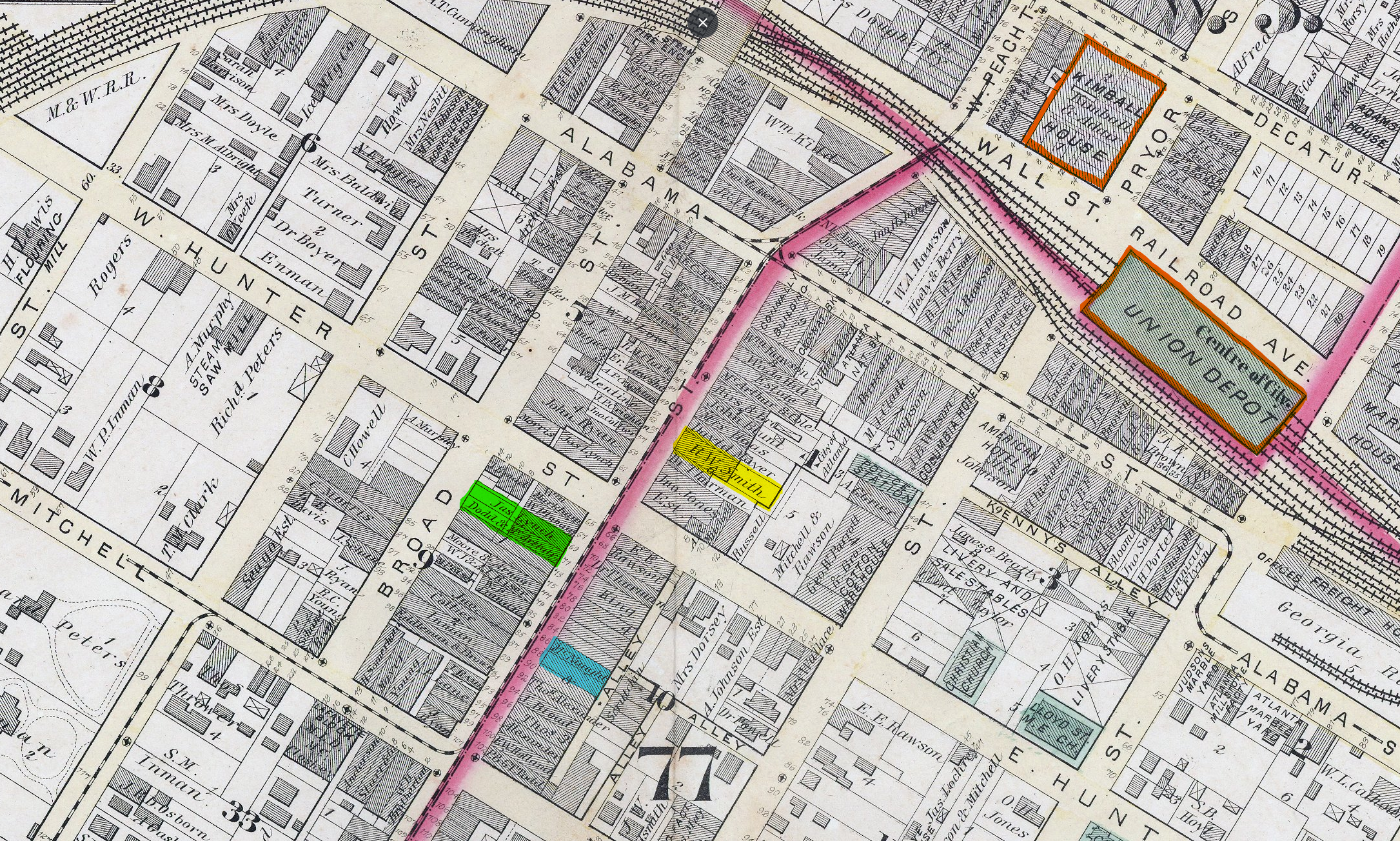
Note the Kimball House and Union Depot outlined in orange at the top right. The Smith estate storefronts are highlighted in yellow at 54 & 56 Whitehall. The 69 & 71 Whitehall storefronts are highlighted in green, they are the property in question in the GA Supreme Court case of Scofield v. McNaught. Finally, the property highlighted in blue is 86 & 88 Whitehall, owned by McNaught.
The advantageous location of the 54 & 56 Whitehall stores is apparent, being only a block and half away from both the Kimball House and Union Depot. While we don’t know exactly when they were rebuilt, we do know that by 1870 multiple retail tenants are in place. The 1870 Hanleiter’s city directory lists the following with references to either 54 or 56 Whitehall:
Alexander L H, cigar store, 54 Whitehall
Valentino G, baker and confec, 54 Whitehall
Cohen, L, dry goods, boots, shoes, 56 Whitehall
Menko M Bro & Co, 56 Whitehall
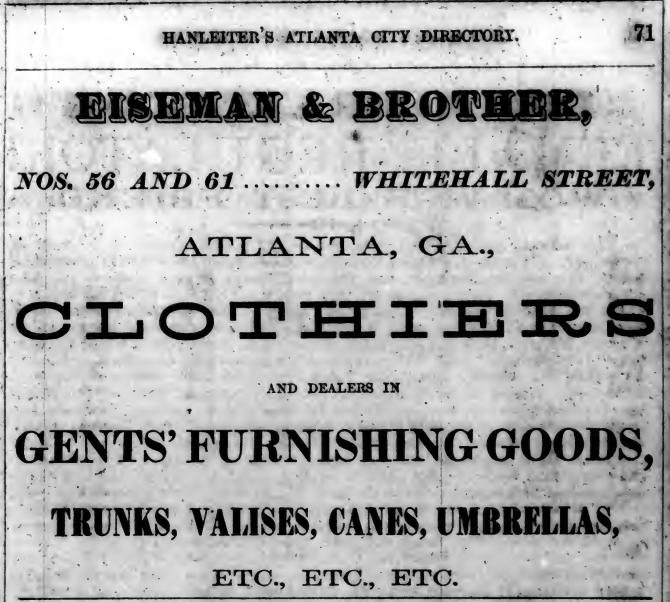
Eiseman & Bro, 56 & 61 Whitehall
1870 Hanleiter’s Atlanta City Directory
The 1867 V. T. Barnwell Atlanta city directory includes a listing for the Eiseman & Bro. store, so they may have actually been operating in the newly rebuilt storefront as early as 1867. The physical location of “east side of Whitehall, near Hunter” certainly lines up.

The Eiseman brothers (German immigrants Jacob and Moses Eiseman) seemed to remain tenants until at least 1873, and by the late 1870s or early 1880s have removed to the Washington D. C. area to open retail establishments there. Here are a few newspaper advertisements I found from when the Eiseman’s were tenants at 56 Whitehall.


Next we will look at the conclusion of the Scofield v. McNaught case, Mary will give birth to her and Robert’s fifth child, and we will review some of the additional retail tenants of the Whitehall storefronts as we wrap up the reconstruction era and move towards the Gilded Age.
 Birds of Kirkwood