

Reconstruction era – 1865-1868
Part of the ‘Smith family history’ series
V. T. Barnwell’s “Atlanta City Directory and Strangers’ Guide” was published sometime in mid-1867. It includes a “Condensed History of Atlanta” section that describes the circumstances of Atlanta residents returning after Sherman’s forces had effectively razed the city.
By those who returned to Atlanta soon after its destruction, a disgusting and heart-sickening scene was witnessed. Ruin, death, and devastation met the eye on every hand. The legions of carrion crows and vultures, whose vocation it might have been to hover over and pick at the decaying carcasses of animals that lay among the scarred and broken walls of our ruined city, were surpassed by the hosts of Georgia’s own sons, who might, otherwise, have been styled our brothers, congregated here from a distance of fifty miles, in every direction – not to guard unprotected property – but, many of them, to steal, and haul away the effects of their absent and unfortunate countrymen.
During the months of December and January, after the destruction of the city by the Federals, some of the citizens, who went South, returned home. A few found shelter in their own houses, while the majority of them were compelled to take up their abode in the houses of other parties, or live in tents with their families. The destitution consequent upon the scarcity of provisions and fuel, and the utter worthlessness of Confederate currency, during the winter months of 1864 and 1865, produced an amount of suffering beyond the comprehension of most persons who did not witness the facts.
Atlanta, during the year 1865, presented quite a picturesque appearance. There might have been seen small houses, put up in many instances expressly for rent, which presented the appearance of having been built of the remnants of half-a-dozen houses.
Barnwell concludes on an optimistic note, evoking the mythological Phoenix which would come to serve as a symbol for Atlanta.
It will be seen that this city, within the past two years, has risen out of her own ashes, to the populous, mercantile, and manufacturing Atlanta of 1861 and 1862. Her future, who can foresee? The tides of immigration and of improvement still continue to flow in her favor.

Robert Windsor Smith owned at least part of the property on Whitehall, specifically on the north side of the street, and he may have had a house there prior to the war. Whether this was gifted or bargained for from his father prior to his death in 1861 or from the estate as administered by William McNaught is unknown. In September 1862 Robert penned a letter to his uncle McNaught stating “In a short time I am going down to my own house to live as Mother and I think it is best. I want to fix an addition so that I can have more room for myself.” My assumption is that whatever structure was there would not have survived the Federal occupation and perhaps was rebuilt sometime in 1865-1866. I do not know exactly when Robert and Mary would have begun living there.
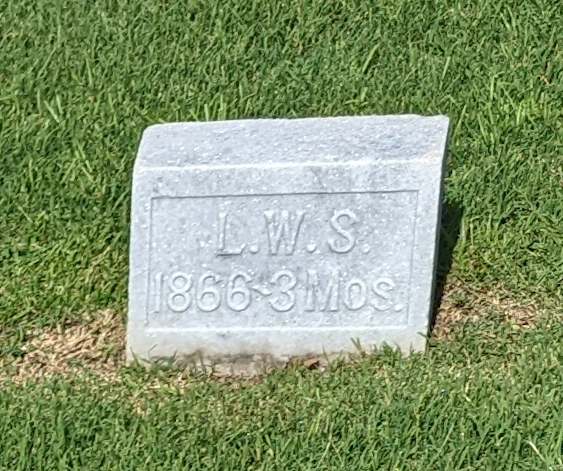
Despite what must have been challenging times for Robert and his new wife Mary Cleveland Wright Smith, they apparently did not wait long to start having a family. Unfortunately, their first-born was not with them for long. Robert and Mary’s first son Lucian Windsor Smith’s gravestone says “L. W. S. 1866 – 3 Mos.”, so my guess is that he was born either early in 1866 or late 1865. There was apparently a smallpox epidemic in Atlanta in December of 1865, whether that was a contributing factor to his death is unknown. It is also unknown whether his birth and/or death were in Atlanta or Cleveland, TN.
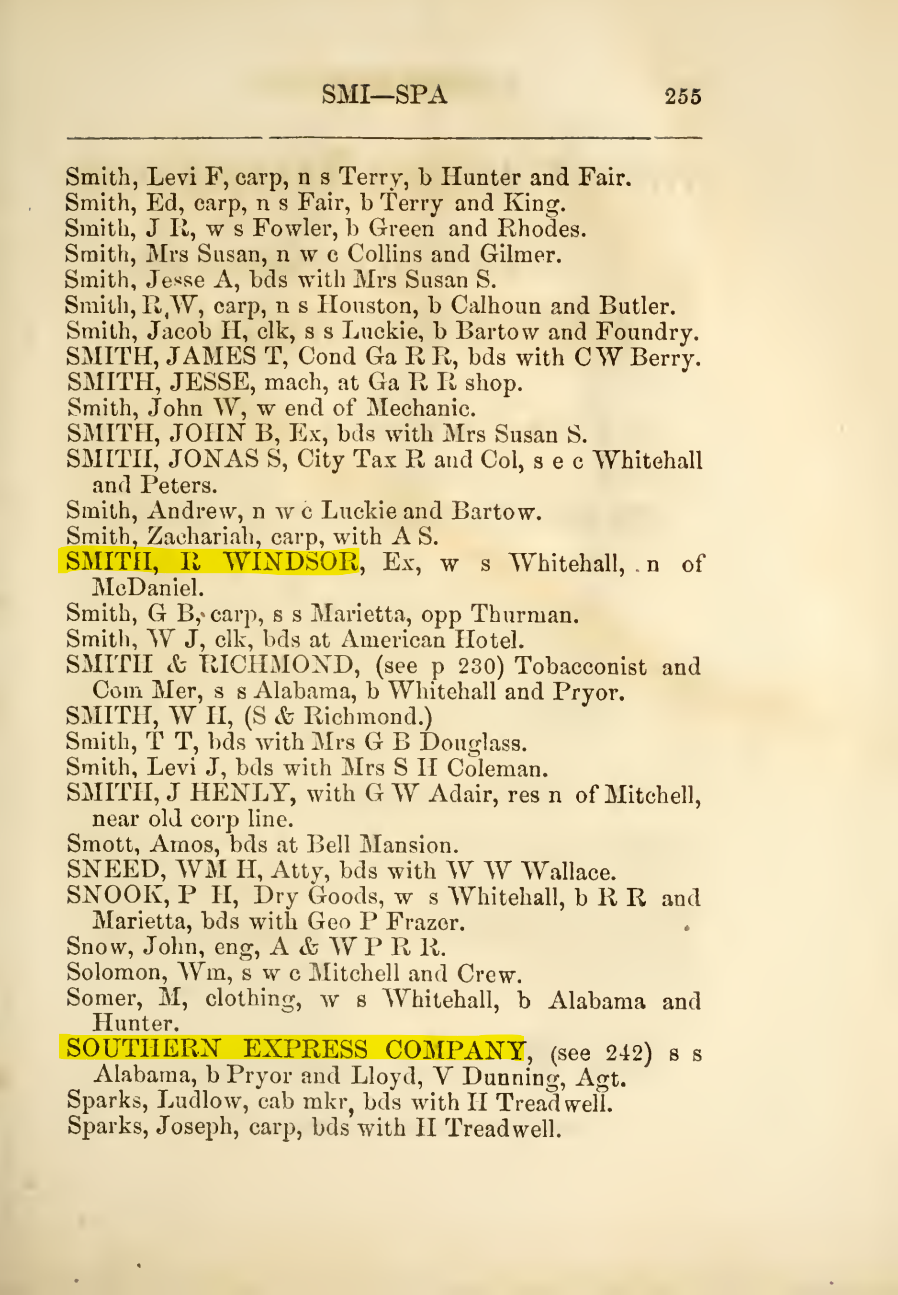
Whatever health issues Robert had been contending with prior to and during his enlistment in the Confederate ranks seem to have been cured by the tides of war, at least to the extent that allowed for him to find work. Barnwell’s 1867 city directory list Robert’s occupation as “Ex” which is an abbreviation for Express Messenger, and his residence as “w s Whitehall, n of McDaniel.”
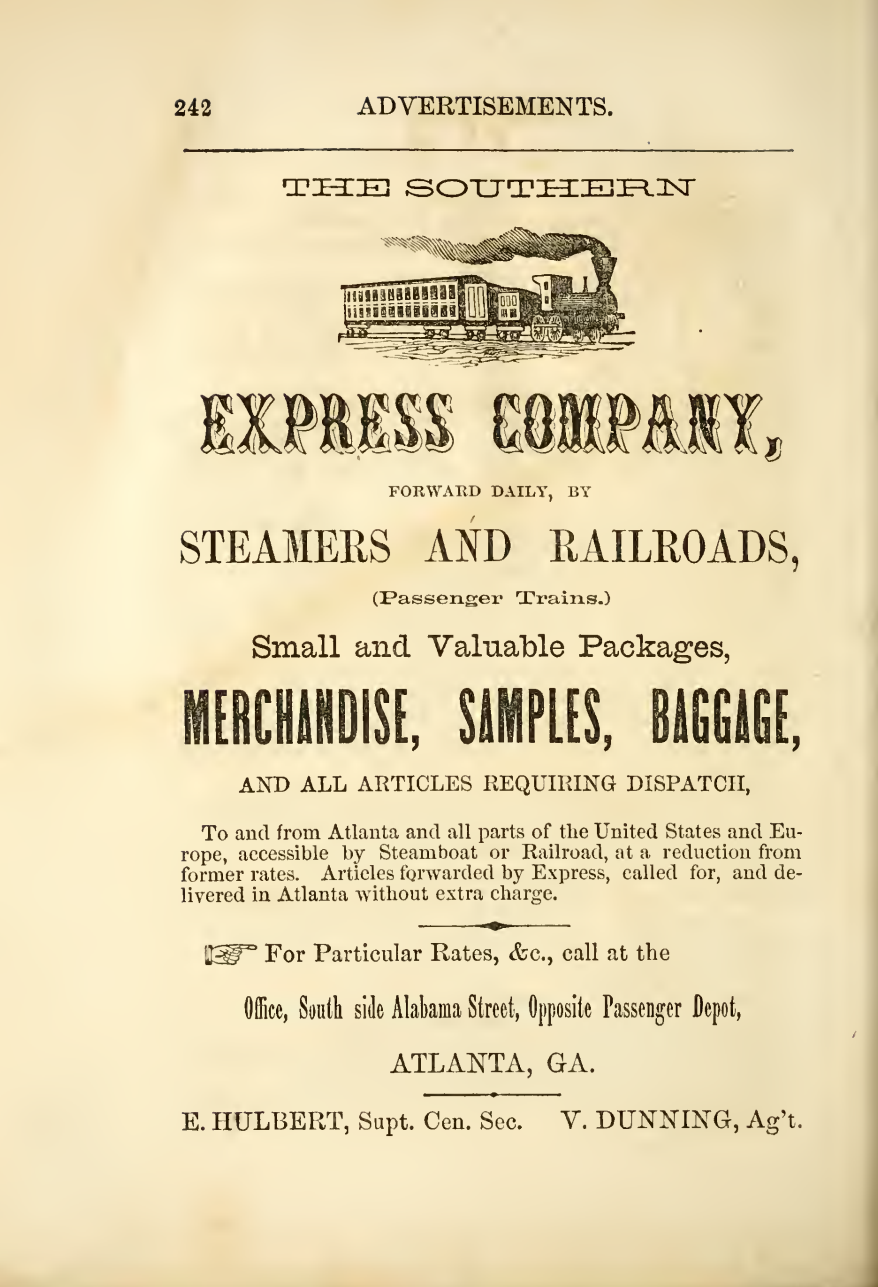
While Robert’s listing doesn’t explicitly say he is working for the Southern Express Company at this time, I believe that he is, and he does so for at least 20 years. The Southern Express Company was founded in 1861 by northerner Henry B. Plant.
Because he had built a reputation for providing reliable and efficient express service, the cabinet of Confederate president Jefferson Davis made Plant’s company the agent for the Confederacy in collecting tariffs and transferring funds.
https://en.wikipedia.org/wiki/Henry_B._Plant
In an article “The Southern Express Company: A Georgia Corporation” appearing in the Georgia Historical Quarterly, Dudley S. Johnson provides additional context and states the following about the role of Express companies following the Civil War:
In the difficult times following the Civil War the Southeastern states still considered the express one of the basic institutions necessary for growth. One newspaper stated ‘in these days of progress the readiest means of transmission and valuables… happens to be offered by the admirably organized express companies.’
The Southern Express Company: A Georgia Corporation
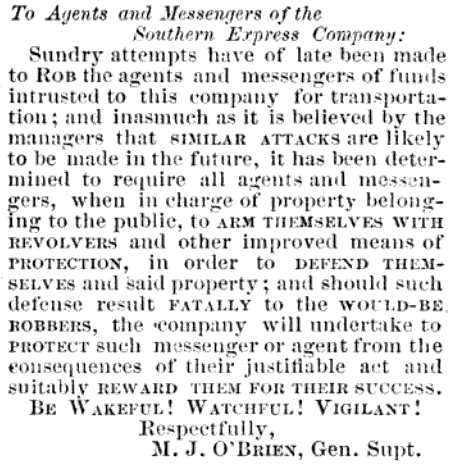
What led Robert to this line of work is unknown. Perhaps it was his familiarity with the rail systems due to his presumed frequent travels between Atlanta and Chattanooga/Cleveland, TN both before and after the war. His previously stated occupation of “Farmer” in the 1860 U. S. Federal census would not appear again until much later in his life. The job of an expressman at least was able to provide a living for Robert’s family, and opportunity to see the landscape, at least along the rail lines. It was not always a safe proposition though, as much of the expressman’s job revolved around the transport of funds. In addition to, at times, requiring contracted security via agencies like the Pinkertons, railway expressmen frequently had to arm themselves as was suggested in this notice to Southern Express Company messengers found in The Expressman’s Monthly in December of 1875.
On September 20, 1867 Robert and Mary welcomed their son Eugene Everton Smith into their lives. Atlanta was still recovering from the war, but the population had grown back to over 20,000 in 1867. The population would grow to over 30,000 by 1870. Following the war a Georgia Constitutional Convention was held in early 1868, and a vote following the convention led to Atlanta replacing Milledgeville as the capital on a temporary basis.
 Birds of Kirkwood