

Civil War – Aftermath
Part of the ‘Smith family history’ series
In early 1865 Atlanta lay in ruins, Abraham Lincoln had been re-elected, and Sherman’s forces had completed their March to the Sea, capturing Savannah. Robert Windsor Smith was registered as a deserter on March 9, 1865 in Charleston, South Carolina. One month later on April 9, 1865 Robert E. Lee surrendered the Army of Northern Virginia, and Lincoln was shot five days later on April 14th, dying the next morning. On April 26, General Joseph Johnston surrendered the Confederate Army of Tennessee, Confederate president Jefferson Davis was captured on May 10, and by the end of May the Civil War was effectively over.

I’m not aware of the exact circumstances of the Smith family living in Cleveland, TN immediately after the war, nor do I know the whereabouts of Robert’s new bride Mary Cleveland Wright Smith at this time. By September 1865, we do know that Robert Windsor Smith had made his way back to Cleveland, TN. The following letter from Robert, his mother Eveline, and his eldest sister Mary to William McNaught is in the McNaught papers at the Atlanta History Center.

9/5/1865 letter transcription
Cleveland, Tennessee
September 5, 1865
Mr. McNaught
Dear Sir,
We have concluded to trust entirely to your judgement as to the rebuilding of the burned house on Whitehall St as we deem you better qualified in such business than we. Therefore you may lease the lot, as you think will be best for us and the younger children.
Yours Truly,
R. Windsor Smith
Eveline M. Smith
Mary K. Smith
This letter tells us definitively that the Smith family house on Whitehall, Confederate General John Bell Hood’s headquarters during fighting in Atlanta, was in fact burned and destroyed. The Whitehall storefronts were also destroyed. William McNaught wrote the following to the Ordinary for Fulton County on October 24, 1865, stating that “two brick stores on the east side of Whitehall Street, between Alabama & Hunter in the City of Atlanta, have been burned down in the general destruction of Atlanta by the Federal Army under command of Gen. Sherman.”
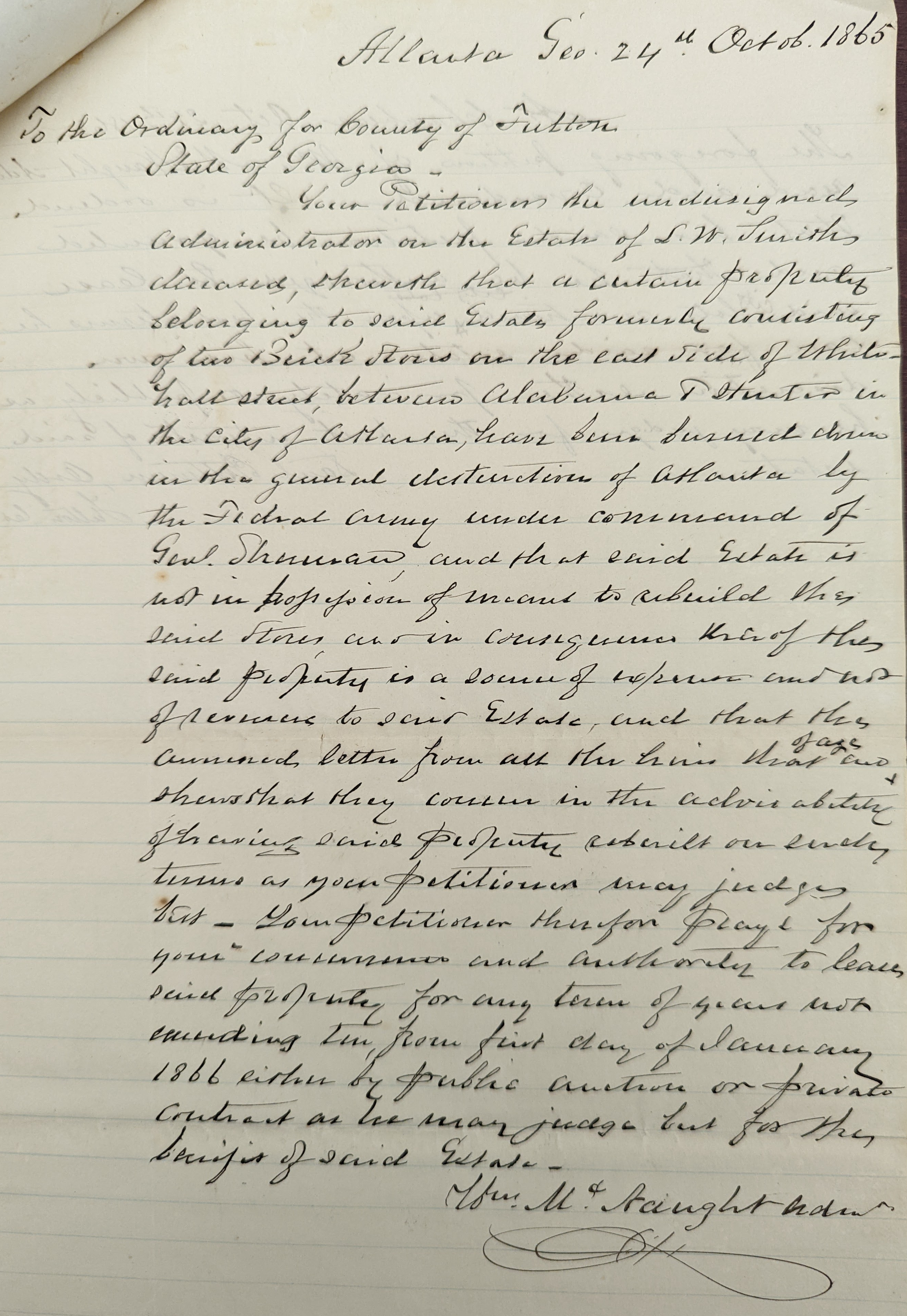
10/24/1865 letter transcription
Atlanta, Geo. 24th Octob. 1865
To the Ordinary for County of Fulton
State of Georgia
Your petitioner, the undersigned administrator of the Estate of L. W. Smith, deceased, (?) that a certain property belonging to said Estate formerly consisting of two brick stores on the east side of Whitehall Street, between Alabama & Hunter in the City of Atlanta, have been burned down in the general destruction of Atlanta by the Federal Army under command of Gen. Sherman and that said Estate is not in possession of means to rebuild the said stores, and in consequence (?) if the said property is a source of expense and not of services to said Estate, and that the (?) letter from all the heirs of age and (?) they concur in the advisability of having said property rebuilt on (?) terms as your petitioner may judge.
Your petitioner therefor prays for your (?) and authority to lease said property for any term of years not exceeding ten, from first day of January 1866 either by public auction or private contract as he may judge best for the benefit of said Estate.
W. McNaught
So we know that the considerable L. W. Smith estate in Atlanta (administered by Robert’s uncle William McNaught) had suffered considerable losses, as I imagine did all property owners in Atlanta. The 1864 Atlanta tax digest lists the aggregate value of the L. W. Smith estate at $58,000. The stated amount is clearly in Confederate dollars.

Less than two months after McNaught’s letter to the Fulton Ordinary, Robert’s mother Eveline marries Meredith Webb Legg in Tennessee on December 21, 1865. I’m fairly confident that Legg sold the Cleveland, TN farm property to the Smith family based on correspondence from Eveline to McNaught. One can imagine that the Smith family was somewhat desperate and presumably had little to no money to pay Legg for the note on the farm. Legg had been previously married, but had been a widower since his wife Jane Ann Cozby Legg had died in June of 1856.

In the next post we will start looking at Robert and Mary’s life in Atlanta during the Reconstruction era.
 Birds of Kirkwood