

Civil War
Part of the ‘Smith family history’ series
I’m certainly not a Civil War historian, but I will try to provide some contextual information along with comments specifically relevant to the Smith family. On September 29, 1862 Robert Windsor Smith had written to his uncle William McNaught stating:
The Conscription Act has concluded to take care of me. I have been enrolled and will know my destination in a week or ten days. I do not think they will put me in the ranks, but probably find employment for me in some hospital.
Robert was referring to the second conscription act which the Confederate congress had passed on September 27, 1862. However, by October 31, 1862 Robert had received a “certificate of ill health” which allowed him to avoid enlistment at that time.
By early 1864 the war was not going well for the Confederacy. Following their November 1863 defeat in Chattanooga, Confederate forces had retreated into Georgia and were clearly experiencing a shortage in manpower. A third conscription act was passed on February 17, 1864 effectively making available all white men aged 17-50 for enlistment.

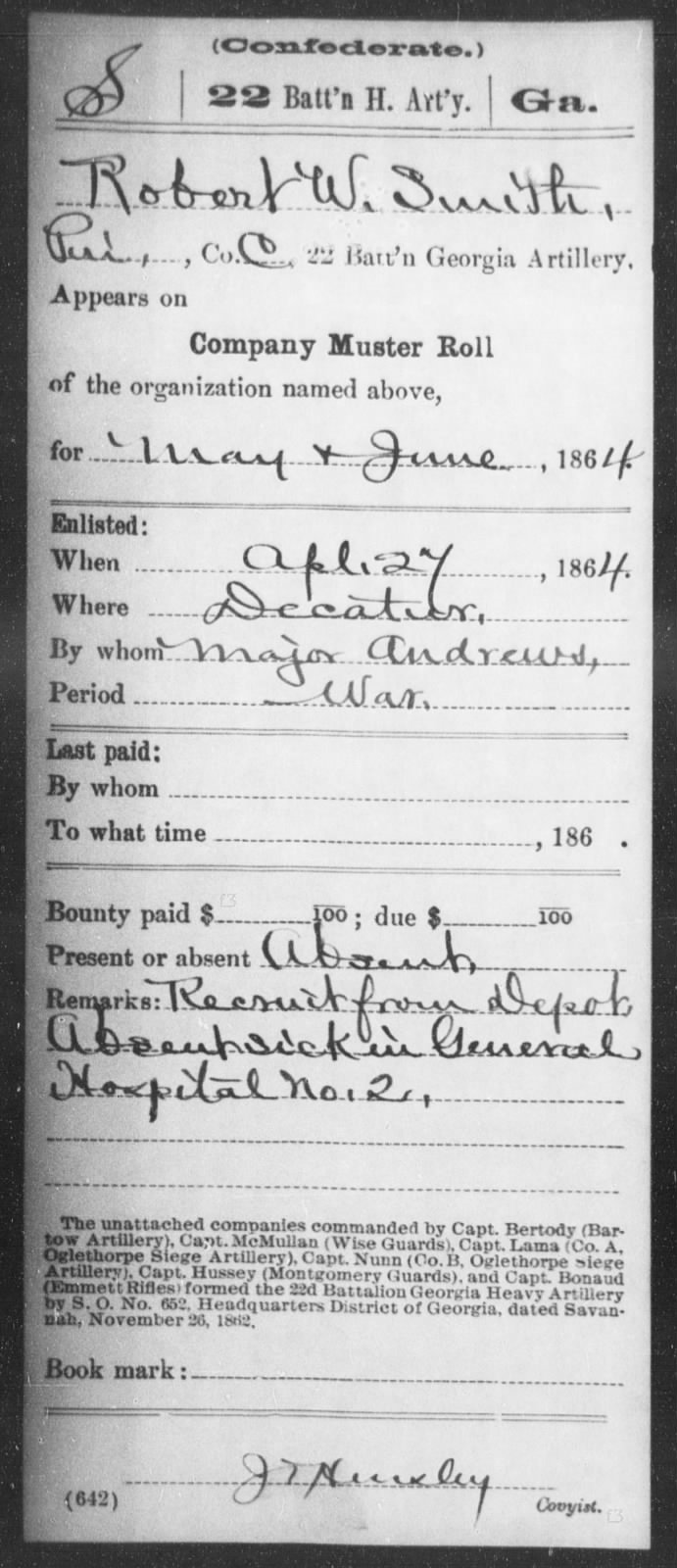
On April 27, 1864 Robert Windsor Smith is enlisted in Decatur, GA by a Major Andrews. This is less than 1 month after his marriage to Mary Cleveland Wright. Robert served as a private in Company C, 22nd Battalion Georgia Heavy Artillery.
22nd Artillery (Siege) Battalion was organized at Savannah, Georgia, during the summer of 1861 with six companies, increased to nine in the spring of 1864. Many of the men were from Burrow, Oglethorpe, Montgomery, and Cobb counties. The unit was attached to the Department of South Carolina, Georgia, and Florida, and served in the Georgia coast at Fort Pulaski and Fort McAllister. In 1865, operating as infantry in Elliot’s Brigade, it saw action in the North Carolina Campaign and surrendered with the Army of Tennessee. The field officers were Lieutenant Colonel William R. Prichard, and Majors J.B. Gallie, Lawrence J. Guilmartin, and Mark J. McMullan.
https://www.nps.gov/civilwar/search-battle-units-detail.htm?battleUnitCode=CGA0022BAH
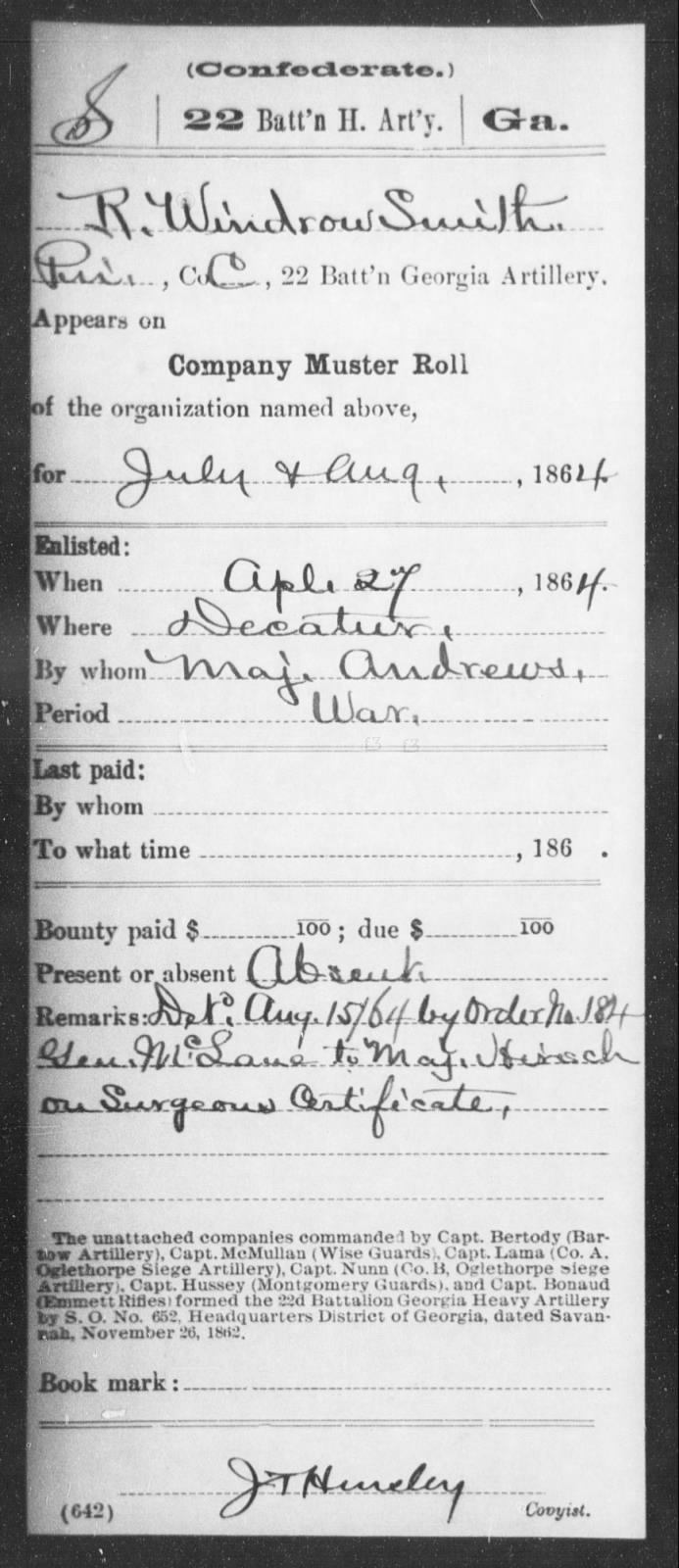
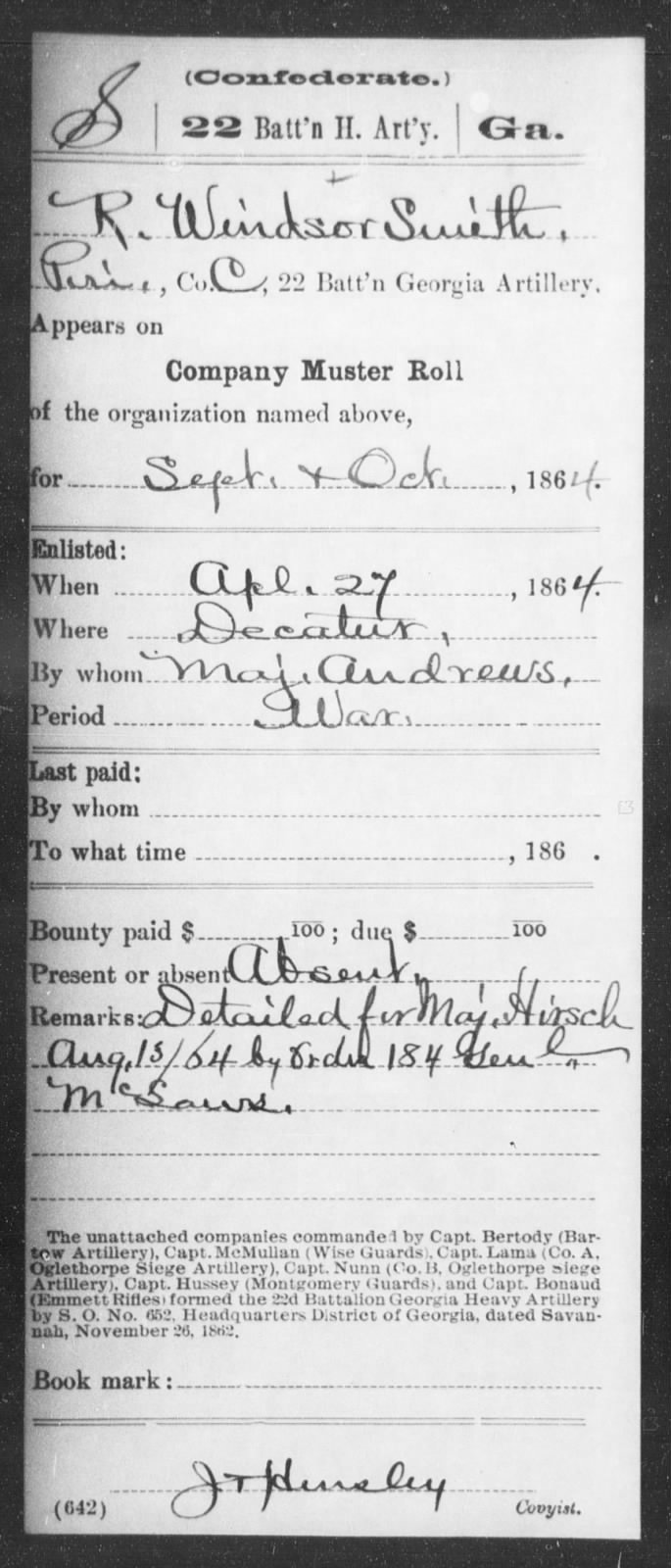
It is unclear whether Robert’s enlistment was voluntary or due to conscription, but his prediction about being placed in a hospital seems to have been accurate. The 1864 muster rolls for May & June, and July & August show Robert absent due to special order 184, which was apparently a leave of absence due to physical disability.
Meanwhile, Sherman’s forces were marching towards Atlanta and fought with Confederate General Joseph Johnston’s Army of Tennessee in late June in the Battle of Kennesaw Mountain. Apparently Sherman’s forces suffered significantly more losses than Johnston’s, but a flanking maneuver allowed Union forces to advance closer to Atlanta, forcing the Confederate forces to retreat once again.

On July 18, 1864 Confederate President Jefferson Davis promotes John Bell Hood to General after relieving General Joseph Johnston of command of the Army of Tennessee preparing to defend Atlanta from Sherman’s impending approach from Chattanooga. The following day General John Bell Hood occupies L. Windsor Smith’s (presumably vacant) house on Whitehall.
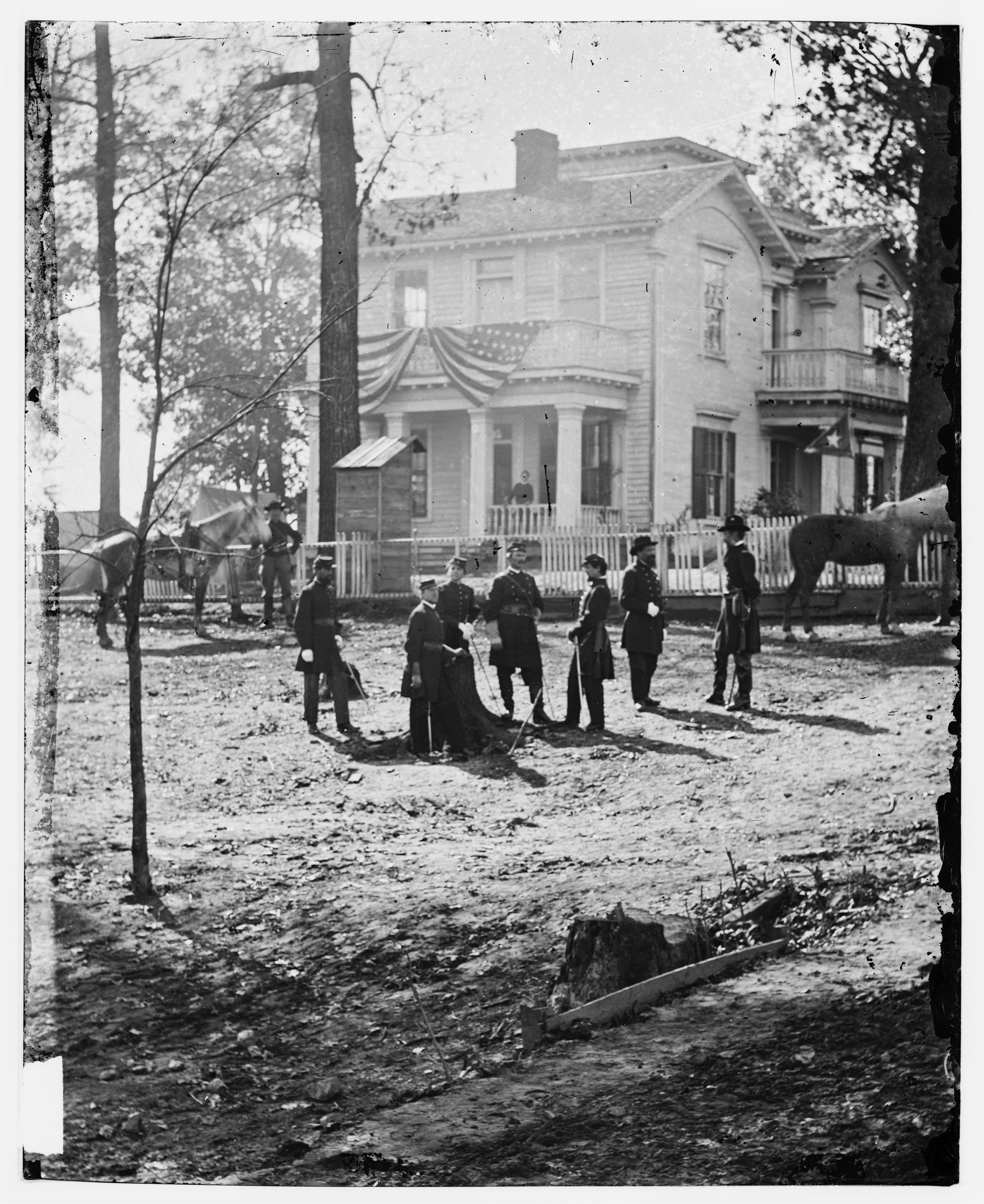
General Hood moved into the L. Windsor Smith house on Whitehall Street near Hunter, by evening. It was known as the “finest wooden building in the city.” His junior officers were not at all surprised that their young leader, now that he had successfully intrigued for power, would commandeer an ostentatious G.H.Q.
Last Train From Atlanta, A. A. Hoehling
During the fighting at Ezra Church and through the month of August, 1864, General Hood’s headquarters were on the southeast side of Whitehall Street, at a point where Hood Street, named in his honor, was later cut. At the time of Hood’s occupancy the property was owned by the estate of L. Windsor Smith, pioneer Atlanta land owner, for whom both Windsor and Smith streets are named, and who had died in Bradley County, Tennessee, on July 8, 1861. The Smith home, a two-story white frame structure surmounted by a cupola, was doubtless occupied by Hood’s staff, although the General himself operated from a tent in the backyard.
Atlanta and Environs, Vol. 1, Franklin M. Garrett
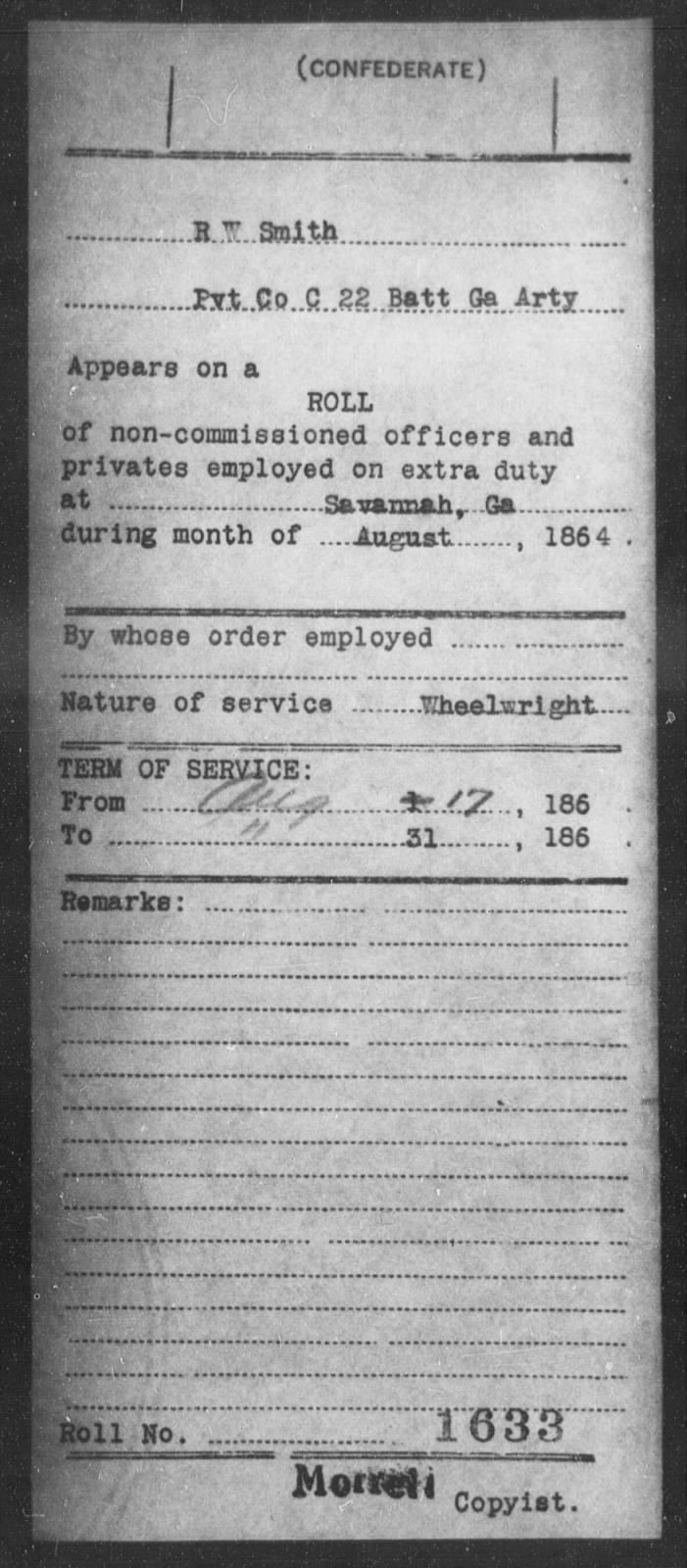
While General Hood was occupying Robert’s father’s home, Robert was in Savannah with the 22nd Battalion Georgia Heavy Artillery. Interestingly I found an “extra duty” record of one “R W Smith” from his company serving as a wheelwright in Savannah in August, 1864. There appear to be no other Smiths in Company C with those initials, so I think we can assume it was Robert, despite his apparent health issues.
Fighting continued in Atlanta throughout July and August, 1864. Finally on September 1, 1864, Hood’s forces evacuate Atlanta and Sherman sends his famous “So Atlanta is ours and fairly won” telegram to Washington on September 3. The Union forces occupied Atlanta for over two months, and Sherman occupied the John Neal house, also known as the Neal-Lyon-Neal house. I’ll briefly discuss this house in a future post.

Amazingly there are two photos of what I imagine was Robert Windsor Smith’s childhood home, his late father’s house on Whitehall, occupied by General John Bell Hood during the Atlanta campaign. The photos were presumably taken sometime in the Fall of 1864 by George N. Barnard and show Union Colonel Henry A. Barnum and his staff in the yard and posing on the porch of the house.

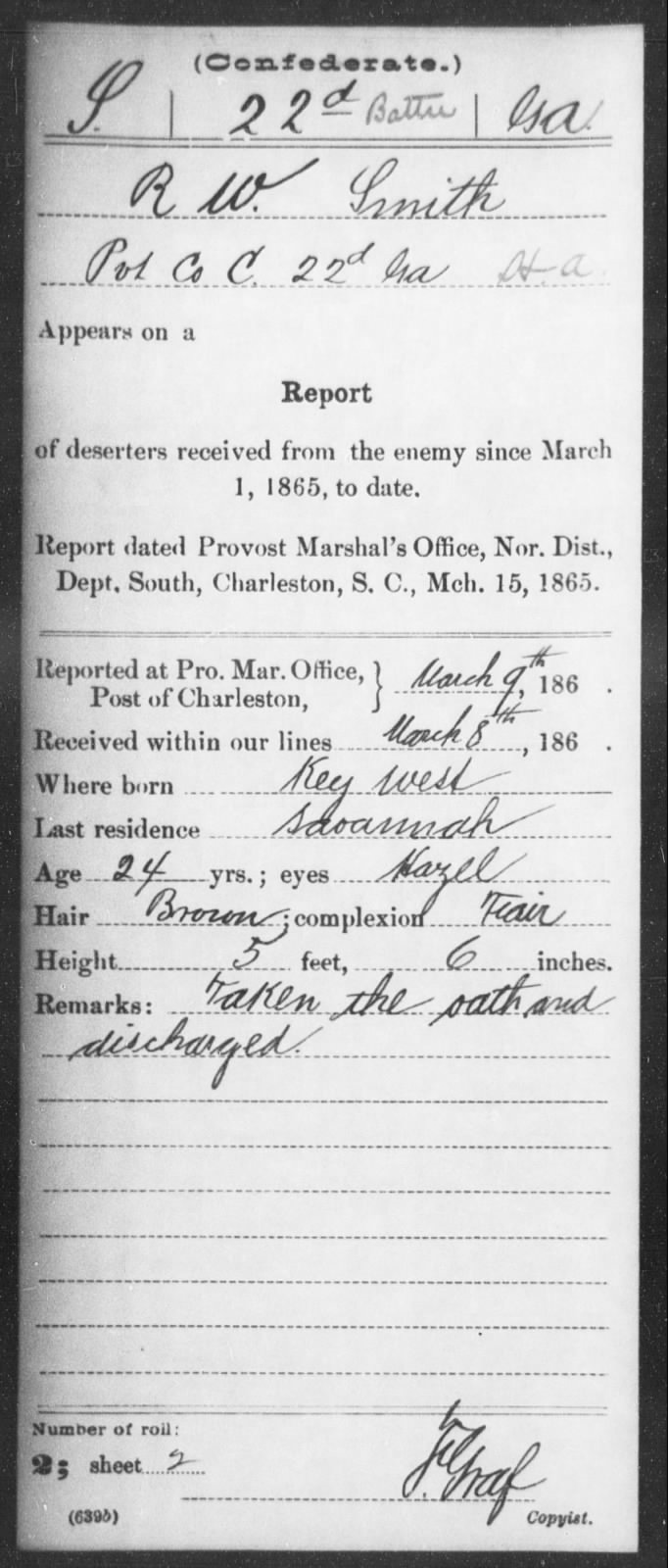
By mid-November Union forces dismantled and then burned much of Atlanta, including the house on Whitehall. Sherman’s March to the Sea commenced on November 15, 1864 and his forces arrived in Savannah on December 10, 1864 meeting little resistance. Robert Windsor Smith was presumably still in Savannah around this time, but I’m not sure of the movements of him or his company. On March 8, 1865, with the Civil War winding down, Robert is reported as surrendering to the Union Provost Marshal’s Office in Charleston, South Carolina. Robert takes the oath of allegiance and is discharged. The report includes the following physical description of Robert:
Age: 24 years; Eyes: Hazel
Hair: Brown; Complexion: Fair
Height: 5 feet, 6 inches
Up next we will look at the period after the Civil War leading into the Reconstruction era.
 Birds of Kirkwood