

L. Windsor Smith – Last will and estate
Part of the ‘Smith family history’ series
Larned Windsor Smith passed away at his property acquired from Meredith Webb Legg in Cleveland, TN on Jul 7, 1861. Bradley county records were apparently burned by Union forces so there is no record of the transaction. I was able to locate Larned’s last will and testament dated June 23, 1861, two weeks before his death. My assumption is that the will was drawn by a lawyer named J. H. Gaut who along with Larned’s widow Eveline is named executor of his will.
There is really no way to sugarcoat this, the will is both racist and sexist, as one might expect from a Civil War-era southern enslaver. Larned’s will includes bequests of the following enslaved people:
- Lizzie, bequeathed to wife Eveline
- Nelly, bequeathed to daughter Mary (aged 10)
- Ellen, bequeathed to son Windsor (Leonard Windsor, aged 8)
A summary of the other bequests are as follows:
- Eveline received a daguerreotype of L. Windsor Smith and ⅓ of his personal estate not otherwise bequeathed.
- Robert, Mary, Windsor, and Eva received the remainder of the estate, but Robert and Windsor were to receive twice as much as each daughter.
- Robert received the lower part of the Cleveland, TN farm at the price of $2,548.
- The upper part of the farm is left to Eveline and the children until the youngest, Eva, is 21 years old. Once Eva is 21, Windsor has liberty to purchase the upper part for what it is reasonably worth.
- Robert received a gold watch.
- Mary received a patent lever French clock.
- Windsor received a compass and chain.
- Eva received a gold locket with L. Windsor Smith’s likeness.
Note that twenty-year-old Robert is bequeathed half of the farm property, but not without a fairly substantial price attached to it. I believe this becomes a point of some contention between Robert and his mother as we will see in a later post.
As I mentioned in the previous post, on his deathbed Larned appoints William McNaught as “full and lawful agent for the transactions of all kinds of business real or personal in the state of Georgia.” A letter sent from Robert to McNaught on September 2, 1861 includes a power of attorney designation drafted by J. H. Gaut.

9/2/1861 transcription
Cleveland, September 2nd, 1861
Dear Uncle,
Enclosed please find Power of Attny, which Mother requests me to send you. Mr. Gaut says the laws of Tennessee do not require it to be recorded, but if it is necessary in Georgia send back and it can be done. Mother wants if possible to collect a little for her. Windsor has had the fever and though yet in bed is getting well.
Yours Truly
R W Smith
P. S. Mother will write Saturday, after she has seen Mr. Gaut.
On December 9, 1861 McNaught is named as administrator of Larned’s estate in Georgia and would serve in that capacity for nearly 30 years. On January 5, 1891 his administration of the estate is finally dismissed.


The “Dear Uncle” salutation in Robert’s letter above is an important clue about the relationship of the Smith family with William McNaught. William McNaught (6/30/1814 – 4/13/1896) was a Scotsman married to Eveline Spencer Smith’s younger sister Judith Spencer McNaught (7/15/1828 – 5/23/1882). McNaught was involved with a business partner James Ormond III in Florida, and I believe eventually settled in Key West prior to the Hurricane of 1846, and married his wife Judith. After the storm it seems several Spencer family members, including Eveline’s brother Robert and sister Judith migrated north to the area south of Tallahassee, near Wakulla, St. Marks, and Newport.
McNaught and Ormond were involved with construction of the ~1850 Georgia and Florida plank road that was to run from Newport, FL to Thomasville, GA. Both McNaught and Ormond eventually moved to Atlanta, sometime around 1858 or so. Prior to their move Larned wrote several letters to McNaught and assisted with preparations of properties for both McNaught and Ormond. Ormond’s papers are housed in the University of Florida and contain his “Reminiscences of the life of James Ormond, 1892.” On page 60 Ormond states the following:
My house was intended to be a modest one story cottage of four rooms with piazzas front and rear, but left in the hands of a Yankee architect and Mr. Windsor Smith it expanded into an extensive mansion of 17 rooms.
Reminiscences of the life of James Ormond, 1892 – https://ufdc.ufl.edu/IR00003201/00037/images/62
McNaught and Ormond were operating at least one storefront on Whitehall, presumably a hardware store, both prior to and after the Civil War. By 1860 McNaught was serving as the first chair of the Metro Atlanta Chamber, his likeness can be seen in this linked image at the Atlanta History Center. During the civil war he and Ormond ran a (failed) blockade running endeavor, and later operated the Sugar Creek Paper Mill located just south of Kirkwood.
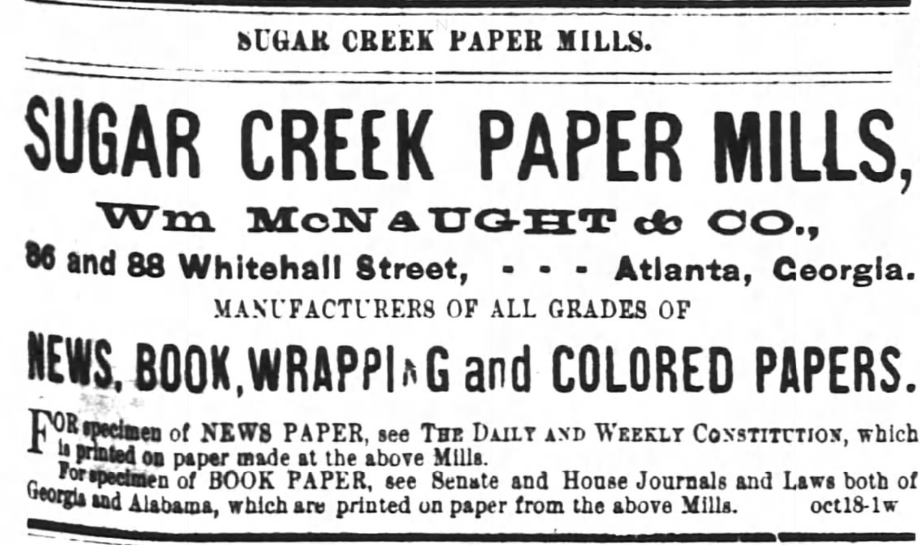
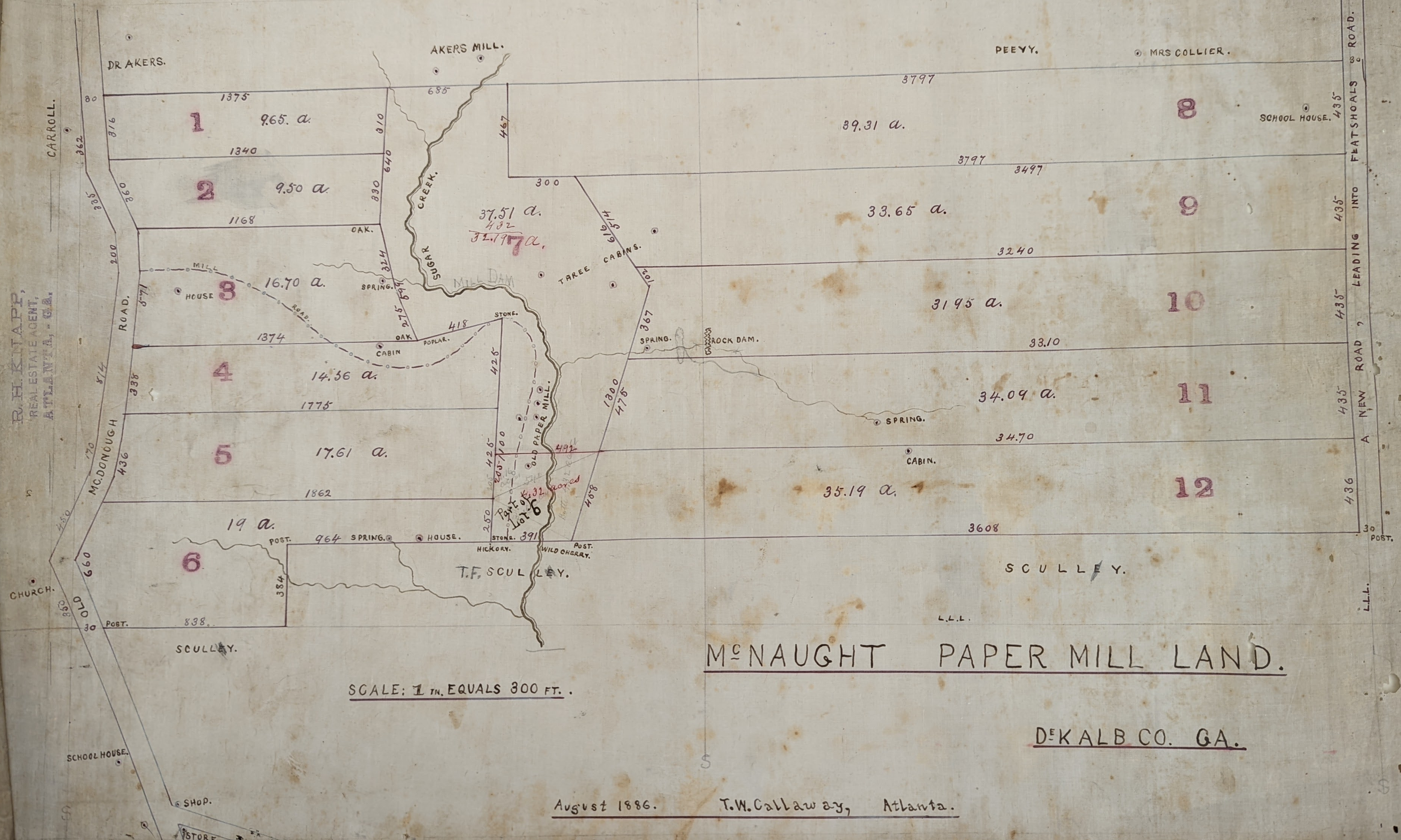
The Atlanta History Center has correspondence between the Smith family and William McNaught, with some letters written from Eveline Smith to her sister Judith McNaught. Much of the correspondence entails LWS’s widow Eveline requesting money be sent from Atlanta to the family in Cleveland, TN. In the next post I will mention some of the highlights of the correspondence, primarily with regard to Robert Windsor Smith.
 Birds of Kirkwood