

L. Windsor Smith – “Virtually in the wilderness”
Part of the ‘Smith family history’ series
After the devastation of the 1846 “Great Havana Hurricane” and the loss of 1 year old second son Clark Smith it is not difficult to see why Robert’s father Larned wanted to make a change. That change would be yet another significant move, this time from Key West to fledgling Atlanta. To help understand what Atlanta was like when they arrived, I’ll provide a little context via some quick notes on early Atlanta history.
- 1821 – The First Treaty of Indian Springs results in the Muscogee (Creek) ceding 4,000,000 acres to Georgia.
While I am certainly no authority on the matter, I may share some additional thoughts in the future about the displacement of native Creek, Cherokee, Seminole, and other people from the southeast to, curiously enough, near where I was born in Tulsa, Oklahoma. - 1822 – DeKalb County is created, including the land where Atlanta sits today.
- ~1830 – Charner Humphries (11/11/1795 – 4/4/1855) moves to DeKalb County.
- ~1835 – Charner Humphries establishes the “White Hall” inn & tavern (located approximately where the West End MARTA station is today in Atlanta). White Hall was named thusly due to its white exterior paint. According to Franklin M. Garrett in his Atlanta and Environs, “Whitehall, in its heyday was a tavern, stage coach stop, post office, and election precinct.”

- 1836 – GA State Legislature authorizes the Western & Atlantic railroad between Chattanooga and a Southeastern Terminus which eventually became Atlanta.
- 1838 – Construction of the W & A railroad begins.
- 1839 – Settlements near the zero mile post of the W & A are founded and named Thrasherville, later known as Terminus.
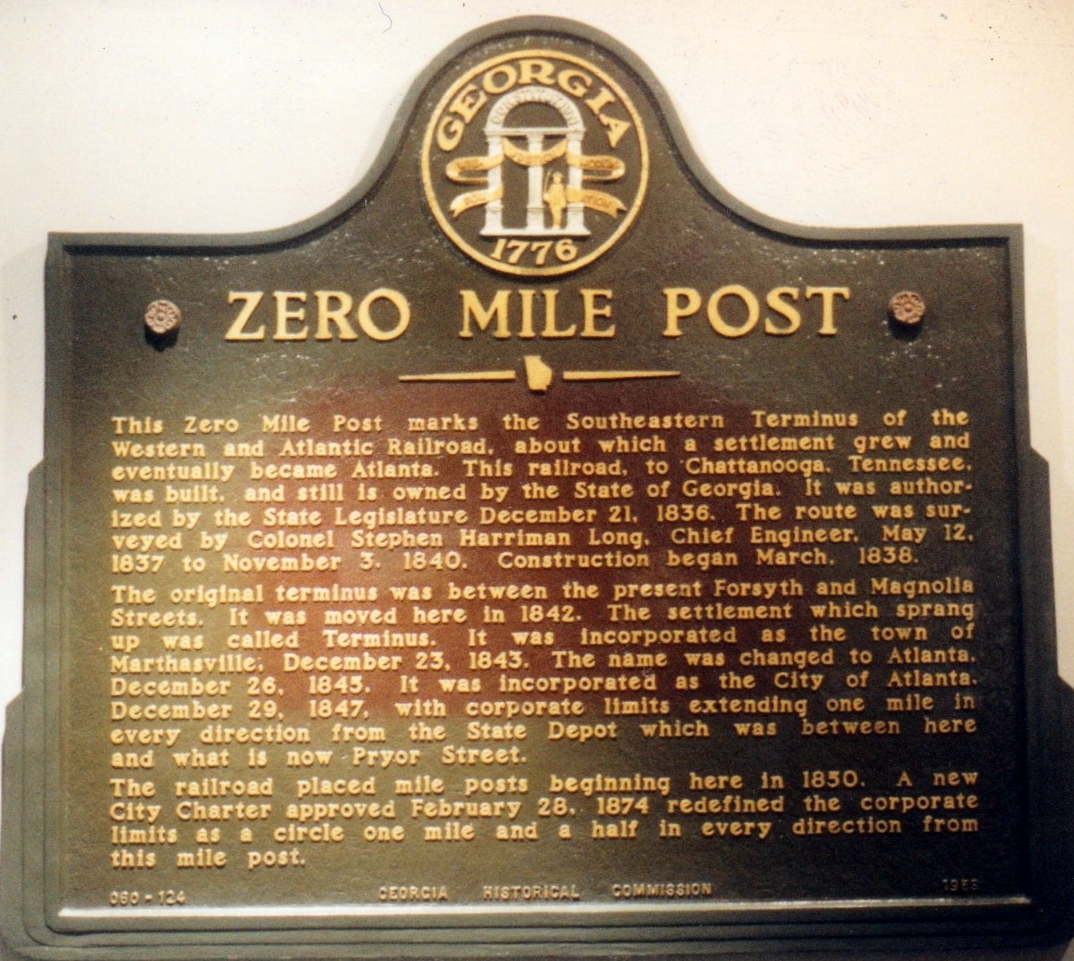
- 1842-1843 – The town has 6 buildings and 30 residents and is renamed to Marthasville and incorporated.
- ~1845 – The first 20 miles of the W & A railroad are in operation connecting Marietta and the Marthasville terminus.
- ~1845 – The 171 mile Augusta-Terminus (Atlanta) connection of the Georgia Railroad is in operation.
- 12/26/1845 – Marthasville is renamed to Atlanta.
- 12/29/1847 – The town is reincorporated as Atlanta.
- 1/29/1848 – Moses Formwalt of the Free and Rowdy Party is elected as the first mayor of the City of Atlanta, defeating Jonathan Norcross of the Moral Party.
The four key railroads under construction that would converge on Atlanta between 1845-1850 were the following:
- Georgia Railroad
- Western & Atlantic Railroad
- Atlanta & West Point Railroad
- Macon & Western Railroad

Based on all that, we can see that Atlanta truly was still in its infancy in 1848, and the significant role that the railroads would play in its growth. The convergence of these important rail lines represented opportunity, and my guess is that opportunity combined with his recent challenges in Florida led Larned to decide that Atlanta was a good destination. On 4/30/1848 Evie and Larned welcomed another son to the family, Charles W. Smith. They may have still been in Key West at this time, but I have not been able to confirm that.
In 1901 Robert Windsor Smith wrote the following:
“In eighteen hundred and forty-eight my father moved from Key West, Florida to Atlanta, Georgia. The place was then a little country town, and the spot upon which our home was built, was virtually in the wilderness.”
“Soon Atlanta outgrew her swaddling clothes, and the far reaching hand of progressive man began to remodel the plan of the little village and in time her barren fields and red clay hills were hidden by the towering walls of a great city.”
I was lucky to find a real estate deed dated 12/16/1848 where Larned purchased 21 1/4 acres from Charner Humphries, the owner of the White Hall tavern, for $425. Fulton County was not created yet, so I was able to locate the record in the DeKalb County court house. In fact, I was very lucky to find the deed, because it is recorded in the oldest surviving deed book for DeKalb County (deed book “L”) that had not been lost in one of the fires that damaged the court house.
In the next post I will include the details of Larned’s initial real estate purchase, other subsequent acquisitions, including maps showing the boundaries of the property.
 Birds of Kirkwood